
Budget 101
The Town of Midland's annual budget is its financial plan for the year. It sets out how the Town collects revenue and spends it to deliver services, maintain infrastructure, and plan for the future.
This webpage explains the main parts of the budget, where your property tax dollars go, and how the budget is approved.
Mayor's Budget
Under Ontario's Strong Mayor legislation, the Mayor of Midland is responsible for proposing the Town's annual budget. Town Council reviews the proposed budget and may recommend amendments in accordance with provincial legislation. The finalized budget determines how Town services, infrastructure, and community priorities will be funded during the year.
Municipal Budget Components
The budget is made up of three parts, and each is funded differently.
Operating Budget
The operating budget covers the day-to-day cost of running the Town and delivering services, such as snow clearing, road and park maintenance, recreation facilities, fire and emergency services, planning and building, tourism and community events. It also includes the Town's contributions to agencies, boards and commissions.
The operating budget is funded by three main sources:
- Property taxes: the Town's largest source of revenue.
- Provincial funding: including the Provincial Gas Tax, and the Ontario Municipal Partnership Fund (OMPF), the Province's main general operating grant to municipalities.
- Non-tax revenue: grants, facility rental and recreation program fees, planning fees, fines and penalties, and interest on investments.
The Town works to maximize non-tax revenue for specific services, which reduces the amount that must come from property taxes.
Capital Budget
The capital budget pays for long-term investments in roads, facilities, parks and technology. Capital projects are funded through:
- Reserves: money the Town sets aside over time for future needs, such as replacing aging infrastructure. Part of what goes into reserves each year comes from the operating budget.
- Government grants: funding from other levels of government, often for specific projects.
- Development charges: fees paid by developers to help fund the roads, water and wastewater systems, parks and facilities needed to serve new growth.
- Debt financing: borrowing money for a project and repaying it, with interest, over a set number of years. The Town uses debt only when needed.
Capital planning helps make sure infrastructure meets community needs while staying financially sustainable.
User Rate Budget (Water & Wastewater)
In Midland, the term User Rate Budget refers specifically to water and wastewater services. Water and wastewater services are not paid for through property taxes. Instead, they are funded by the people who use them through user rates charged on their water/wastewater bill. Rates are reviewed regularly to reflect the cost of service, support infrastructure needs, and meet regulatory requirements. Revenue collected through these rates is reinvested in the water and wastewater systems to help keep them safe, reliable, and sustainable.
Some Town services, such as recreation programs, facility rentals, marina services, and permits, charge user fees. These fees help pay for the services but do not fully fund them. Instead, the revenue from these fees is included in the Town's operating budget alongside property tax revenue.
Where Your Property Tax Dollars Go
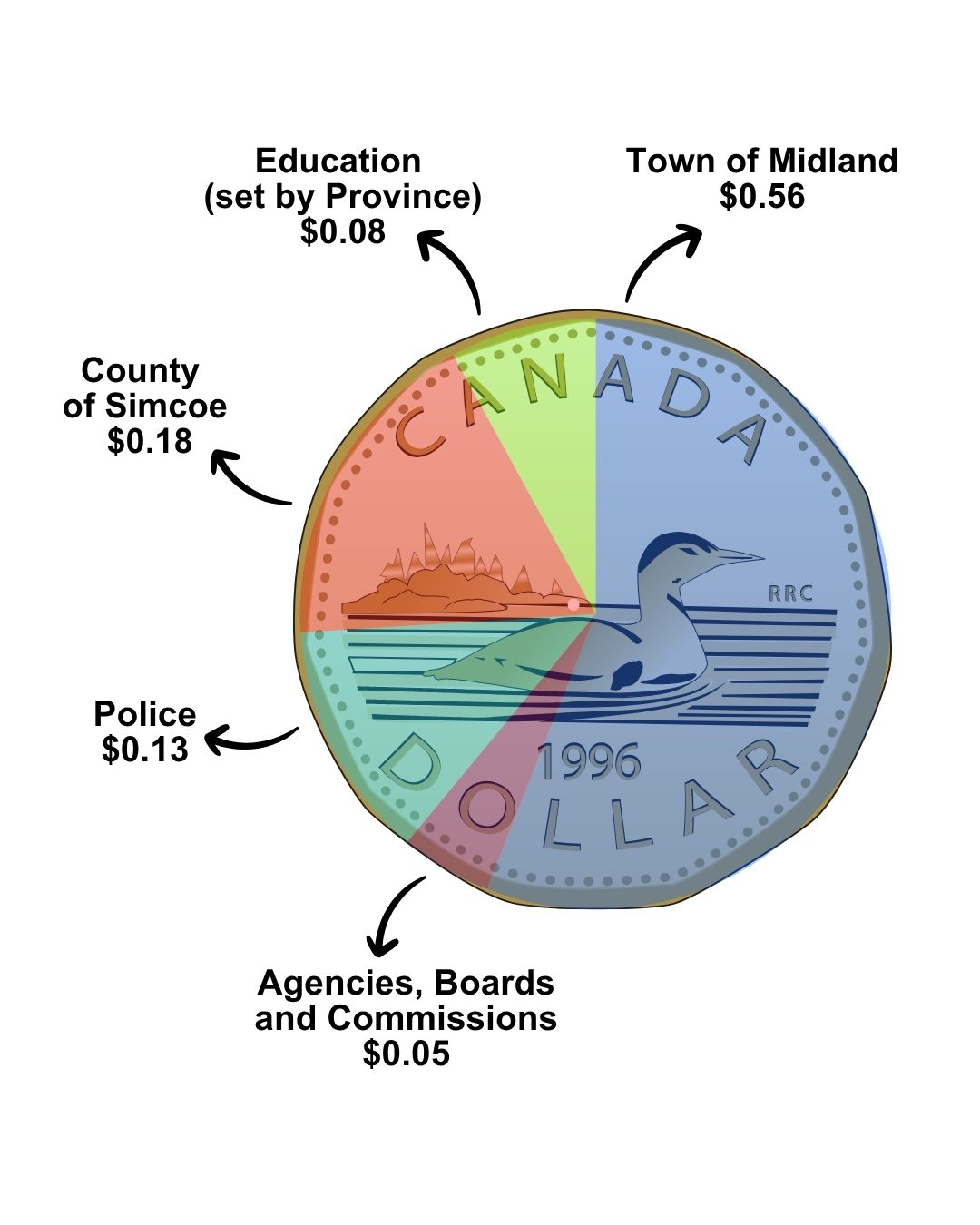
Your property tax bill pays for more than Town-provided services. The Town also collects property taxes on behalf of other organizations and levels of government. Each tax dollar is shared among:
- Town of Midland: snow clearing and road maintenance, fire and emergency services, parks and recreation, transit, planning and building services, by-law enforcement and customer service.
- County of Simcoe: regional services such as waste collection, paramedic services, long-term care, social and housing programs, and more.
- Police services: Midland's contract with the Ontario Provincial Police (OPP) for local policing, including frontline response, community mobilization, court services, auxiliary units and crisis outreach teams.
- Education: set by the Province of Ontario to help fund local school boards, teachers and classroom supplies.
- Agencies, boards and commissions: organizations such as the Midland Public Library, Huronia Museum, Huronia Airport, Severn Sound Environmental Association and Route 93.
Only 56¢ of every tax dollar collected supports Town services. The remaining 44¢ funds services and costs outside the Town's direct control.
Did you know? The Town sets only part of your property tax bill. The rest is collected on behalf of other organizations and levels of government, and your assessed value is set by the Municipal Property Assessment Corporation (MPAC). Learn more about how your property tax bill is calculated.
How Growth Supports the Budget
Each year, the MPAC captures new development and increases in property assessments. This is called realized assessment growth. It expands the tax base, so the Town collects more property tax revenue without raising tax rates for existing property owners. That revenue helps pay for services and offset rising costs.
Growth also helps stabilize water and wastewater rates, by spreading system costs across more customers.
Development charges, paid by developers, help fund the roads, water and wastewater systems, parks and facilities needed to serve new development. Together, assessment growth and development charges help ensure that growth pays for growth.
Paying for Infrastructure Renewal
The Town owns and maintains essential municipal infrastructure such as roads, sidewalks, water and sewer systems, stormwater facilities, public buildings, parks, and other community assets. Each year, the Town invests in replacing these assets, funded by property taxes and water and wastewater user rates.
When this investment is less than what is needed to maintain current levels of service, the difference is called an infrastructure funding gap. To close the gap, the Town would need to gradually increase how much it puts into reserves each year. Reserves are money the Town sets aside to replace aging infrastructure. Part of these contributions comes from the operating budget, so increasing reserves affects the property tax rate.
Budget Process & Public Input
Each year, Town staff review operating pressures, capital project needs and user rate adjustments to prepare a draft budget. Town Council then invites public input, deliberates and approves the final budget, ensuring it aligns with community priorities.
Visit midland.ca/2027budget for the 2027 budget information.